Contact
Département d'informatique
Université du Québec à Montréal
CP 8888, Succ. Centre-ville
Montréal (Québec) H3C 3P8
Phone: 514-987-3000, #5516
Office: PK-4525
Email: blondin_masse[dot]alexandre
[at]uqam[dot]ca
About
I have completed my Ph.D. in mathematics and computer science under the supervision of Professors Srecko Brlek, from Université du Québec à Montréal, in Canada, and Laurent Vuillon, from Université de Savoie, in France.Since August 1st, 2014, I'm a regular assistant-professor at Université du Québec à Montréal, in Canada.
Links
- My profile on Google Scholar
- My GitLab repositories
- My Bitbucket repositories
- My Github repositories
Combinatorics
[français]Symbolic sequences (or words) have many applications that range from data compression to discrete geometry, passing by number theory and physics. A well-known infinite word is the Fibonacci word
where the sequence {fn} is defined by f0 = b, f1 = a and fn = fn − 1fn − 2 for n ≥ 2.
Another notable sequence is the Thue-Morse word
where the sequence {tn} is defined by t0 = a and tn + 1 = tntn and the operator ⋅ swaps the letters a and b.
Taken out of context, these words might seem purely theoretical, but there are many situations in which one discovers some structure encoded by symbolic sequences. For instance, the following path hides the Fibonacci word f described above [4]. It has strong symmetric and fractal properties:
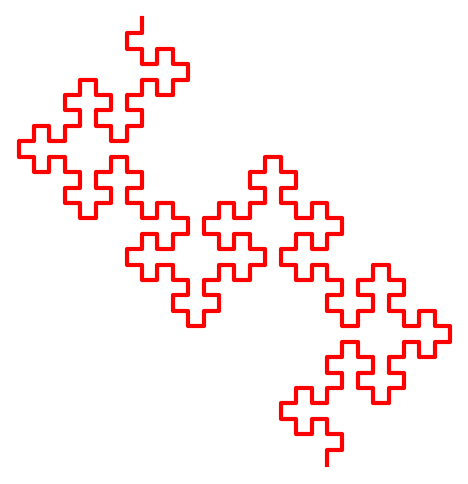
My area of research focuses mainly on discrete geometry using combinatorics on words tools. In particular, I use palindromes and their generalization as a mean of understanding the structure of the combinatorial and geometrical objects.
Palindromic complexity
When studying a given symbolic sequence, it is of particular interest to concentrate on its palindromic factors, i.e. words that read the same backward and forward. Examples of palindromes in French are "ressasser" and "radar". In discrete geometry, palindromes correspond to objects having symmetric properties, such as being invariant under a rotation of angle π or under some reflection.
In [1], Brlek, Hamel, Nivat and Reutenauer introduced the concept of palindromic defect, a statistic on words indicating whether they are full (or rich) in palindromes or not. More precisely, let w be a finite word. It is easy to show that w contains at most |w| + 1 distinct palindromes (including the empty palindrome ε). The defect of w is then defined by
A word is called full if D(w) = 0. It is well-known that Sturmian and Episturmian words are full. Moreover, the Thue-Morse sequence is not full and the exact positions where the palindromes are missed are described in [2]. More recently, we have shown that codings of rotations, a natural generalization of Sturmian words, are full as well [3].
An interesting operator acting on palindromes is the iterated palindromic closure. Let w be some finite word. One defines the palindromic closure of a w as the shortest palindrome having w as a prefix. It is denoted by w( + ). For instance,
since baab is the longest palindromic suffix of abaab. Another remarkable property of the Fibonacci word is that it might be constructed by applying over and over the palindromic closure and adding alternatively the letters a and b on the word:
(a)( + ) = a (ab)( + ) = aba (abaa)( + ) = abaaba (abaabab)( + ) = abaababaaba (abaababaabaa)( + ) = abaababaabaababaaba ⋮
Many different generalizations of the iterated palindromic closure have been studied. One of them focuses on pseudopalindromes or f-palindromes, i.e. a classical generalization of palindromes. Let f be some involution on an alphabet. Then w is called f-palindrome if f(w) = w̃, where ⋅̃ denotes the reversal of a word (the letters are written in reverse order). As an example, the word ACGT is a f-palindrome, where f is defined by A↔T and C↔G. The combinatorics of f-palindrome is widely studied in bio-informatics. The reader interested in the matter might take a look at [5] for further details on my work on f-palindromes and iterated palindromic closure.
Tilings
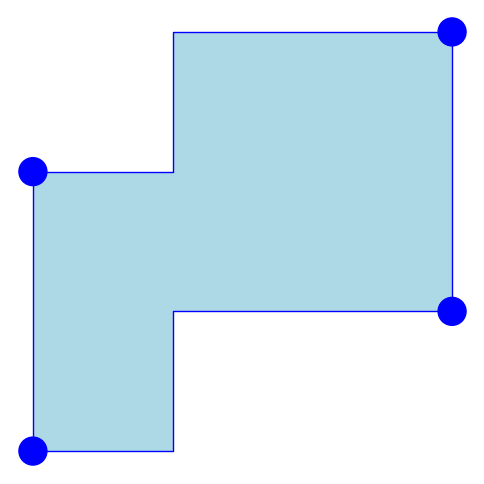
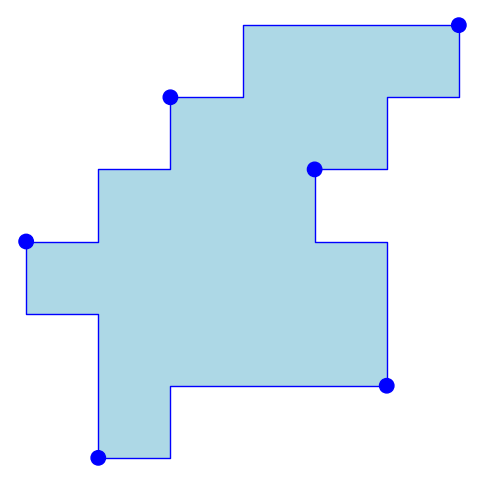
Combinatorics on words provide useful tools to study discrete objects such as polyominoes. In particular, it allows one to characterize those which tile periodically the Euclidean plane ℝ2 by translation. Let P be some polyomino. Beauquier and Nivat proved in [6] that P tiles periodically the plane if it admits some boundary word w (a word on the alphabet {a, a, b, b} coding the moves right, left, up and down respectively) such that
where ^⋅ denote the discrete path traveled in the opposite direction and at most one word among A, B and C is empty. Such polyominoes are called tiles. For example, the two following polyominoes are tiles:
|
|
The left polyomino is called square tile, since the word C is empty. On the other hand, the right polyomino is called hexagon tile as all words A, B and C are nonempty.
In the last years, I have restricted my attention on the families of square tiles, more precisely on polyominoes that admit multiple square tilings. For instance, the following Fibonacci tile is called 2-square tiles (or double square tile):
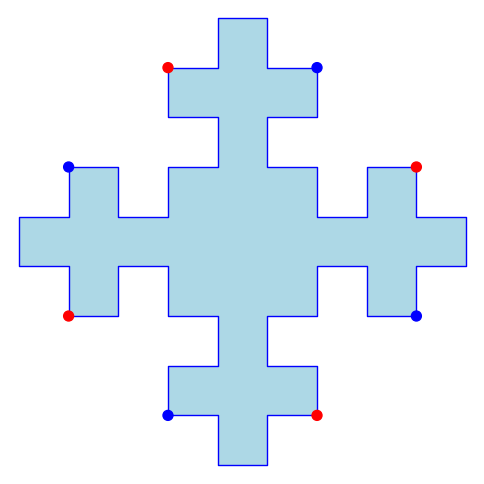
since it admits two distinct square tilings (marked by red and blue dots). In 2008, it was conjectured in [7] that there exists no 3-square tilings. We proved that the conjecture indeed holds in [8]. Finally, we studied in details the enumeration of double square tiles in [9]. The figure below enumerates the first 100 double square tiles:
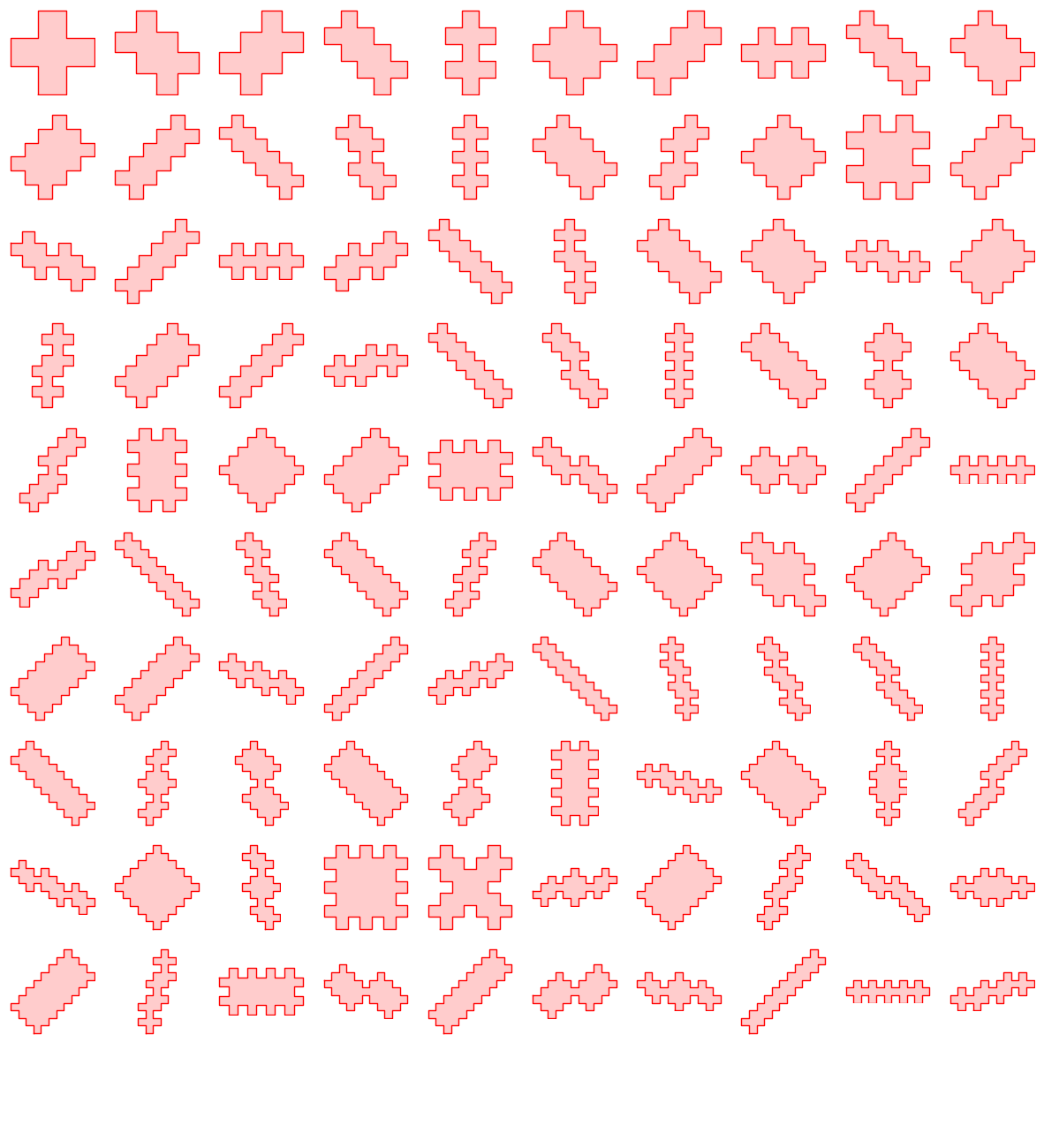
Some open problems still remain for students wishing to be introduced to discrete geometry and combinatorics on words (see for instance [9]).
References
| [1] | S. Brlek, S. Hamel, M. Nivat and C. Reutenauer, On the palindromic complexity of infinite words, International Journal of Foundations Computer Science 15: 2 (2004) 293-306. |
| [2] | A. Blondin Massé, S. Brlek, A. Garon and S. Labbé, Combinatorial properties of f-palindromes in the Thue-Morse sequence, Pure Mathematics and Applications, vol. 19, no. 2-3, 2008, p. 39-52. |
| [3] | A. Blondin Massé, S. Brlek, S. Labbé and L. Vuillon, Return words in codings of rotations, submitted to Theoretical Computer Science on January 6th, 2010, reference TCS-D-10-00024, accepted, under revision. |
| [4] | A. Blondin Massé, S. Brlek, A. Garon et S. Labbé, Two infinite families of polyominoes that tile the plane by translation in two distinct ways, Theoretical Computer Science, in press, 2010, doi: 10.1016/j.tcs.2010.12.034. |
| [5] | A. Blondin Massé, G. Paquin and L. Vuillon, A Fine and Wilf's theorem for pseudoperiods and Justin's formula for generalized pseudostandard words, (JM2010) 13th Mons Theoretical Computer Science Day (September 6th-10th, 2010, Amiens, France) 8p. |
| [6] | D. Beauquier and M. Nivat, On Translating One Polyomino to Tile the Plane, Discrete and Computational Geometry 6: 575-592 (1991). |
| [7] | X. Provençal, Combinatoire des mots, géométrie discrète et pavages. PhD thesis, D1715, Université du Québec à Montréal, 2008. |
| [8] | A. Blondin Massé, S. Brlek, A. Garon and S. Labbé, Every polyomino yields at most two square tilings, Lattice Path 2010, Italy, July 4th-7th, 2010. |
| [9] | (1, 2) A. Blondin Massé, A. Garon and S. Labbé, Generation of double square tiles, GASCom 2010, Montréal, September 2nd-4th, 2010. |